

Table of Contents
- What Counts as a Vintage Stadium Poster in 2026
- Where to Find Vintage Stadium Posters: The Best Sources
- How to Spot Authentic Vintage Sports Posters
- How to Frame Vintage Stadium Prints Without Damaging Them
- Prices, Print Formats and What You Actually Get
- Stadium Posters by Club and Era: What Sells
- Storing and Preserving Your Collection
- Conclusion
- Frequently Asked Questions
Last Updated: September 10, 2026
What Counts as a Vintage Stadium Poster in 2026
A vintage stadium poster is an original or period-era printed artwork depicting a football ground, typically produced close to the time the stadium or a specific season was current. In practice, collectors split these into two camps: genuine period pieces from match programmes, newspapers and club-issued lithographs, and modern archival reproductions printed from original photography.
That distinction matters more than ever. This guide from Football Printz walks through where to find stadium posters, how to verify them, and what to pay.
The market for collectible prints has shifted. Reproductions now dominate search results, and many buyers can't tell a 1960s programme insert from a 2026 reprint until it arrives on the doorstep. Below, we'll show you exactly how to tell them apart before you spend a penny.
Where to Find Vintage Stadium Posters: The Best Sources
The best sources for vintage stadium posters are independent football photographers, specialist dealers, and auction houses that handle sporting ephemera. Each has a different price ceiling and a different authenticity risk. Here's how they compare.
| Source | Typical Price Range | Authenticity Risk | Best For |
|---|---|---|---|
| Independent photographers | £3.99-£40 | Low (original work) | Modern archival prints |
| Specialist dealers | £50-£500+ | Medium | Period originals |
| Auction houses | £100-£2,000+ | Low (vetted) | Rare match-day pieces |
| Online marketplaces | £10-£80 | High | Bargain hunting only |
Independent Football Photographers
Independent photographers are the most reliable source for fans who want stadium wall art that actually looks good framed. You're buying an original image, not a scan of someone else's scan. Football Printz, for example, sells high-resolution digital downloads of grounds like Old Trafford, Anfield and Elland Road from £3.99, plus framed and canvas options.

The advantage is control. You choose the print size, the paper, and the frame. The trade-off is that you're buying a modern photograph, not a period artefact, so don't expect auction-house resale value.
Auctions, Fairs and Specialist Dealers
Specialist dealers and auction houses are where genuine period pieces surface. Expect to inspect items in person where possible, and always ask for provenance: programme inserts, ticket stubs, or a documented source.
A common mistake is assuming an old-looking print is old. Ageing is easy to fake with tea-staining and yellowed paper stock. If a dealer can't tell you where a piece came from, walk away.
How to Spot Authentic Vintage Sports Posters
Authentic vintage sports posters carry three markers: period-correct paper stock, printing method consistent with the era, and documented provenance. Modern reproductions rarely tick all three.
- Paper stock: Older prints use uncoated, slightly fibrous paper. Modern reprints feel smooth and uniform.
- Print method: Look for visible halftone dots under a magnifier on lithographs. Digital reprints show no dot pattern.
- Ink behaviour: Period inks fade unevenly and often shift toward brown. Modern fade-resistant inks stay flat.
- Provenance: Ask for the source. Programme inserts, club shop receipts and auction records all count.
- Edition marks: Limited edition prints should carry a number and a signature or stamp.
For guidance on how cultural institutions assess print authenticity, the British Museum collection care guidance is a useful reference point for paper and ink evaluation.
How to Frame Vintage Stadium Prints Without Damaging Them
Framing vintage stadium prints without damage means using acid-free mount board, UV-filtering glass, and a frame deep enough to keep the artwork off the glazing. Never dry-mount or glue an original. The goal is reversibility: if you ever sell the piece, it should come out of the frame exactly as it went in.
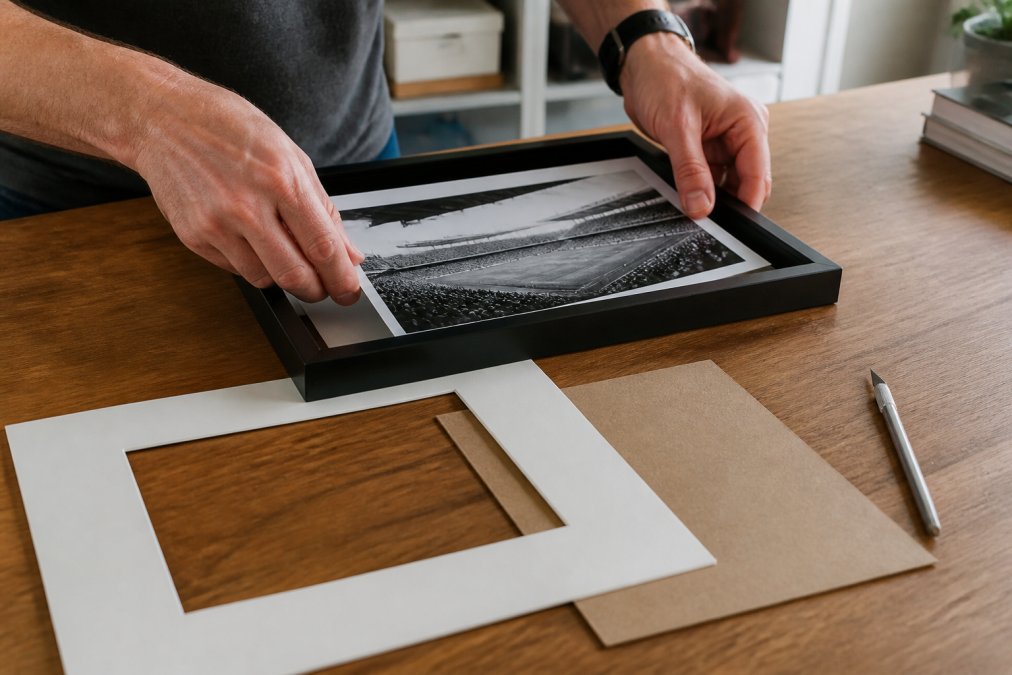
Here's the sequence that works:
- Measure the print and cut an acid-free mount with a 5-8cm border.
- Attach the print to the backing with archival hinging tape at the top edge only.
- Fit UV-filtering glass or acrylic. Standard glass offers no protection against fading (si.edu).
- Seal the back with a dust cover to keep insects and moisture out.
- Hang away from direct sunlight and radiators.
For modern archival prints, this level of care is still worth it. A canvas print from Football Printz arrives ready to hang with a sawtooth hanger included, but a paper print benefits from proper mounting if you want it to last decades.
Prices, Print Formats and What You Actually Get
Prices for vintage stadium posters range from under £5 for a digital download to several thousand pounds for a rare period original. The format you choose matters as much as the source, and the price is usually a direct reflection of four variables: paper weight, ink type, print method, and edition size.
The Price Ladder
- Digital downloads: £3.99-£15. Instant delivery, print at any size up to A3+.
- Unframed posters and prints: £15-£60. Paper quality varies enormously.
- Canvas prints: £30-£80. Ready to hang, no glazing needed.
- Framed prints: £50-£150. Convenience costs money.
- Period originals: £100-£2,000+. Condition and rarity drive the price.
Football Printz's Old Trafford 2026 canvas print sits at £34.99, which is a fair benchmark for a hand-stretched canvas with a pinewood frame. Digital downloads start at £3.99 for grounds including Anfield, Elland Road and the Racecourse Ground.

What Actually Drives the Price
Paper weight. The thing nobody tells you about cheap prints is that paper weight is where the savings hide. A 200gsm poster looks fine online and feels flimsy in the hand. Archival paper at 250gsm or above is the threshold most collectors won't go below. Above 300gsm you are paying for feel and longevity, not image quality.
Ink type. Dye-based inks produce vivid colour but fade faster. Pigment-based inks cost more and last decades longer under UV exposure. If a seller cannot tell you which they use, assume dye-based.
Print method. Giclée (fine art inkjet) is the standard for archival reproduction. Offset lithography is what most period originals used. A modern offset reprint is cheaper to produce but rarely marketed honestly as such.
Edition size. An open-edition print can be reprinted indefinitely, so it has no scarcity value. A numbered limited edition of 50 or 100 carries a premium because the supply is fixed. Signed editions add another layer.
How to Judge Whether a Price Is Fair
A simple test: divide the price by the paper weight in gsm.
For period originals, condition is the dominant factor. Foxing (brown age spots), tears, and fading can cut value by half or more. A framed original with UV glass and acid-free mounting will hold value better than an unframed one stored in a drawer.
Stadium Posters by Club and Era: What Sells
Certain clubs and eras hold value far better than others, and the reason is almost always historical rather than aesthetic. Manchester United's Old Trafford, Liverpool's Anfield and Leeds United's Elland Road consistently rank among the most requested grounds, driven by decades of top-flight history and large supporter bases. But the deeper pattern is that scarcity follows demolition, redevelopment and rebranding.
Why 'Lost' Grounds Outperform Current Ones
A stadium that still stands can always be photographed again. A stadium that has been demolished cannot. That single fact drives most of the premium in this market.
- Maine Road (Manchester City, 1923-2003): Demolished after the move to the City of Manchester Stadium. Period material from the 1934 FA Cup era or the 1968 title season is scarce because the ground no longer exists to generate new imagery.
- Highbury (Arsenal, 1913-2006): Converted into apartments. Original programme covers and match-day lithographs from the 1930s and 1970s circulate in small numbers.
- The Baseball Ground (Derby County, 1895-1997): A classic example of a ground whose visual record is almost entirely photographic, making surviving printed artwork disproportionately valuable.
- Roker Park (Sunderland, 1898-1997): Similar pattern. Pre-war material is rare; 1973 FA Cup final memorabilia is the accessible entry point.
- The Old Den (Millwall, 1910-1993): A ground with a fierce cultural identity and very little surviving commercial print.
A common pattern among collectors is that 'lost ground' pieces trade at a meaningful premium over equivalent-condition prints of stadiums that are still in use, even when the clubs are of similar stature.

Era Premiums and Why They Exist
Era matters just as much as club. Pre-1970s artwork commands a premium because less survived, printing runs were smaller, and paper was not designed to last. The 1990s and 2000s are the sweet spot for affordability, with plenty of supply and strong nostalgia for fans now in their thirties and forties.
The 1980s sit in an awkward middle: too recent to feel antique, too old to be contemporary, and often produced on poor-quality paper that has not aged well. Condition therefore matters more than era for this decade.
Newer Grounds and the 'First Season' Effect
Newer grounds are a different proposition. Everton's Hill Dickinson Stadium at Bramley-Moore Dock is already generating interest as a first-season piece, and Wrexham's Racecourse Ground, the oldest international football stadium in the world, appeals to collectors who value history over silverware.
The 'first season' effect is real but speculative. Prints and programmes from a ground's inaugural season tend to hold interest because they mark a fixed point in the club's timeline, but they rarely appreciate the way pre-war material does. Buy them because you were there, not because you expect a return.
Storing and Preserving Your Collection
Store prints flat, in acid-free sleeves, in a cool dark place with stable humidity. Light, heat and moisture are the three things that destroy paper, and they work faster than most collectors expect.
- Keep unframed prints in archival polyester or acid-free paper sleeves.
- Store flat, never rolled, unless the print has been rolled for years already.
- Maintain humidity between 40-50% where possible (nps.gov). Bathrooms and lofts are the worst places.
- Avoid direct sunlight entirely, even through a window.
- Handle with clean cotton gloves. Skin oils transfer permanently.
For framed pieces, dust the glass with a dry microfibre cloth and never spray cleaner directly onto the surface. Canvas prints can be wiped gently with a clean, damp cloth if dust builds up.
Conclusion
The hardest part of collecting vintage stadium posters isn't finding them. It's telling a genuine period piece from a convincing reprint, and knowing which format suits your wall and your budget. Get the verification steps right and the rest falls into place.
Football Printz exists for the fans who want original stadium photography without the guesswork. Every image is shot and edited in-house, available as an instant digital download or a ready-to-hang canvas, with 30-day hassle-free returns and secure checkout. Whether you're after Old Trafford, Anfield or the Racecourse Ground, you're buying a piece of the ground you love, printed with care. Shop now and bring your club's home ground into your home.
Frequently Asked Questions
How do I verify the authenticity of a vintage stadium print?
Ask the seller for the photographer's name, the date the image was taken, and the original negative or digital file it came from. Genuine sellers state clearly whether an item is an original photograph, a licensed reproduction or a digitally restored print. Check for a copyright line, a print run number and a paper or ink description. If a listing claims 'original 1960s' but shows no provenance, treat it as a modern reproduction and price it accordingly.
What is the difference between a vintage-style print and an original stadium poster?
An original poster was printed at the time of the match or season it promotes, on period paper with period inks, and it ages in a specific way. A vintage-style print is a modern piece made to look retro, often using black and white photography, sepia tones or bold retro typography. Both can look superb on a wall. The difference matters for price and for insurance, so ask sellers which one you are buying before you commit.
Where can I find high-quality retro stadium wall art for my home office?
Independent football photographers are the strongest option because you can see exactly which ground was shot and when. Football Printz, for example, sells original stadium photographs of grounds such as Old Trafford, Anfield, Elland Road, the Racecourse Ground and Everton's Hill Dickinson Stadium as instant digital downloads from £3.99, plus a stretched Old Trafford canvas print at £34.99. Digital files print cleanly up to A3+, so you can size the piece to your wall.
Are vintage stadium posters considered a good investment?
Rare originals from major finals and long-demolished grounds do hold and grow in value, but they are a small part of the market. Most stadium art is bought to be enjoyed, not traded. If resale matters to you, buy signed or numbered limited editions from named photographers, keep the receipt and certificate, and store the piece flat in acid-free sleeves. Treat anything sold as decoration as decoration, and you will not be disappointed.
How do I care for a framed stadium print so it lasts?
Keep it out of direct sunlight, because UV light fades inks faster than anything else. Hang it away from radiators, kitchens and damp walls, and aim for steady room temperature and humidity. Dust the glass with a dry microfibre cloth rather than spraying liquid near the frame. If the print is valuable, ask a framer for UV-filtering glass and acid-free mount board, which together add years to the life of the paper.