

Table of Contents
- Start with the Right Measurements for Your Poster
- Acrylic vs Glass for Framed Posters: Which Wins?
- Selecting the Best Frame for Sports Photography Prints
- How to Match Frame Colours and Materials to Your Space
- Protecting Football Prints from Sunlight and Damage
- DIY Framing vs Professional Services: A Decision Matrix
- Visualise Your Framed Poster Before You Buy
- Final Checklist for Choosing the Right Frame for Posters
- Frequently Asked Questions
Last Updated: September 7, 2026
Choosing the right frame for posters is the difference between a print that looks like an afterthought and one that anchors an entire room. For football fans, this decision carries extra weight: you are preserving a memory of a stadium, a match-day atmosphere, or a club's history. For football fans, this decision carries extra weight: you are preserving a memory of a stadium, a match-day atmosphere, or a club's history.
Start with the Right Measurements for Your Poster
Measure your poster before you look at any frames. A common mistake is assuming the print size matches the frame size, but the frame opening is always smaller than the outer dimensions. You need the exact dimensions of the artwork itself, measured edge to edge, to find a frame with a matching interior opening.
The frame profile and rabbet depth matter here. The rabbet is the groove inside the frame that holds the glass, mat, and backing. A shallow rabbet will not hold thicker mounting materials, and if you plan to add matting, you need extra depth. A gap of a few millimetres around the print prevents buckling when humidity changes.
Take these measurements before ordering:
- Poster height and width to the nearest millimetre
- Thickness of the paper if you plan to use spacers
- Desired mat width if you want a border
Acrylic vs Glass for Framed Posters: Which Wins?
Acrylic wins for most framed posters because it is lighter, safer to handle, and offers better UV protection than standard glass, making it the practical choice for larger prints and homes with children or pets (moma.org). Glass offers superior clarity and scratch resistance, but it is heavy and can shatter if knocked.
For a football print you plan to keep for years, the debate comes down to placement. Acrylic with UV-filtering glazing blocks a significant portion of damaging light, which matters if the frame hangs opposite a window. Standard glass is cheaper but offers little protection against fading.
Consider these factors when deciding:
- Acrylic: lightweight, shatter-resistant, blocks UV rays, prone to scratching during cleaning
- Glass: clearer optics, scratch-resistant, heavier, hazardous when broken
Selecting the Best Frame for Sports Photography Prints
The best frame for sports photography prints depends on the image content, but black and dark wood profiles consistently outperform ornate styles for stadium scenes. Sports photography relies on contrast and geometry, and a busy frame competes with the image. A clean, straight profile keeps the eye on the pitch and the architecture.
For aerial stadium shots, a wide black frame with a white mat creates a gallery-style presentation. For moody sunset prints, a darker wood frame with warm undertones enhances the golden light. Metal extrusion frames in matte black or silver suit modern interiors and offer a slim profile that works well in tight spaces.
Consider the print's dominant tones. A print with deep green pitch and blue sky pairs well with a classic black frame, while a sepia-toned historical image benefits from a natural wood finish that echoes its warmth.
A Unique Angle: Framing for Digital and Giclée Prints
Most framing guides assume you are working with a traditional offset lithograph or a photographic print. But if you are framing a modern digital print or a giclée, a high-resolution inkjet print on fine-art paper, your frame choice has a second job: it must bridge the gap between a file and a physical object.
How to Match Frame Colours and Materials to Your Space
The frame should connect the artwork to the room, acting as a bridge between the image and your furniture, flooring, and wall colour. A black frame suits minimalist spaces with concrete or white walls, while walnut or oak frames warm up rooms with wooden floors and leather sofas.
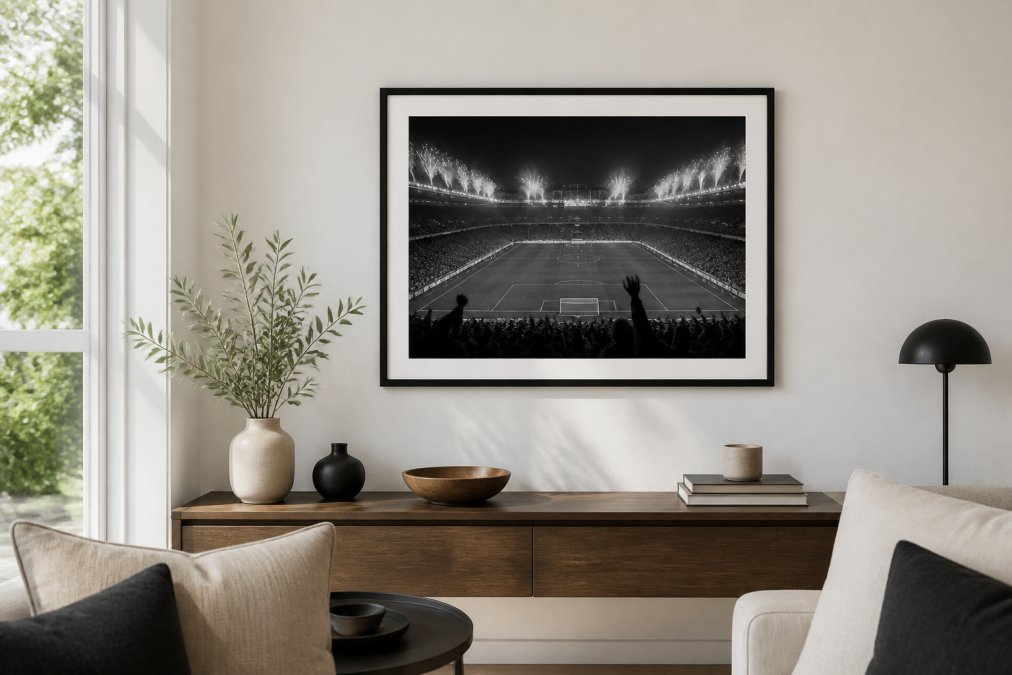
If your sofa is grey and your print features a red stand, a black frame works. If the room is full of oak furniture, a light oak frame ties the piece into the space.
Tonal contrast matters more than exact colour matching. A dark frame against a light wall creates a crisp boundary, while a light frame on a dark wall lets the artwork float. For a gallery wall with multiple prints, keep all frames in the same finish for a cohesive look, and vary the mat widths instead for visual interest.
Material Profiles: Wood vs. Metal vs. Composite
The material you choose affects both the look and the longevity of the frame. Here is how the main options compare in practice:
Solid wood frames are the default for a reason. They offer structural rigidity that prevents warping over time, especially important for larger prints. The finish matters as much as the species. Ash and maple take light stains well, giving a pale, Scandinavian look. Walnut and cherry darken naturally with age. Oak is the most stable choice for large formats, but it is heavy; a 60cm x 90cm oak frame can weigh over 3kg before glass.
Metal frames, typically aluminium, are the best choice for a slim profile and a modern aesthetic. They are lighter than wood, which reduces wall load, and they do not warp in humid environments like kitchens or bathrooms. The finish is usually anodised or powder-coated. The main trade-off is that metal frames have a shallower rabbet depth, so they are less suitable for thick mat stacks or canvas-mounted prints.
Composite frames (made from MDF or resin with a wood veneer) are a budget-friendly middle ground. They mimic wood grain well but are more prone to chipping at the corners and can sag under heavy glazing. They are fine for standard-size prints under 50cm, but for anything larger, solid wood or metal is a safer long-term investment.
Sustainability: A Growing Consideration
A recent shift in consumer priorities is the demand for eco-friendly framing materials. If sustainability matters to you, look for frames certified by the Forest Stewardship Council (FSC), which guarantees the wood comes from responsibly managed forests.
For metal frames, check whether the aluminium is recycled. Anodised aluminium is infinitely recyclable without losing quality, and some manufacturers now advertise a minimum of 50% recycled content (aluminum.org). Avoid composite frames with a plastic foil wrap, as these are difficult to recycle and often end up in landfill.
Protecting Football Prints from Sunlight and Damage
Direct sunlight is the fastest way to ruin a football print, causing colours to fade and paper to yellow within a couple of years (loc.gov). UV-filtering glazing is the single most important investment you can make, as it blocks the majority of harmful rays while keeping the image visible.
Beyond light, humidity and dust threaten the print's longevity. Hang framed posters away from radiators and exterior walls where condensation forms. Use archival quality materials where possible: acid-free matting and a backing board prevent the paper from reacting with the frame over time.
For conservation framing, consider these protections:
- UV-filtering acrylic or glass to block light damage
- Acid-free mat board and backing to prevent paper degradation
- A dust cover on the back of the frame to keep out insects and grime
- Spacers between the print and the glazing to prevent the paper from sticking
DIY Framing vs Professional Services: A Decision Matrix
DIY framing works well for standard sizes and simple prints, while professional services suit large pieces, unusual dimensions, and valuable artwork.
| Factor | DIY Framing | Professional Framing |
|---|---|---|
| Cost | Lower | Higher, custom work starts around £80 |
| Time | Immediate, done in an afternoon | Several days to weeks |
| Customisation | Limited to standard sizes | Any size, mat, or profile |
| Protection | Basic, standard glass | Archival, museum-grade options |
| Skill Needed | Basic assembly | None, handled for you |
If your poster is a standard size like A2 or A3 and you are comfortable with a screwdriver, DIY framing is a reasonable route. For a limited edition print or a large aerial stadium photograph, the precision of professional mounting and the quality of archival materials justify the cost.
Visualise Your Framed Poster Before You Buy
Picture the finished piece on your wall before you commit, because a frame that looks good on a shelf can overwhelm a small wall or disappear against busy wallpaper. Use painter's tape to mark the frame dimensions on the wall and live with the outline for a day.
Consider the viewing distance. A large print in a hallway is seen from close range, so a slim frame suits the intimate setting. In a living room viewed from across the room, a wider frame gives the piece more presence.
Measuring the aspect ratio of your print against the wall space helps, too. A horizontal aerial shot of a stadium works best above a console table or sofa, where the width mirrors the furniture below.
Final Checklist for Choosing the Right Frame for Posters
Before you buy, run through this checklist to confirm you have made the right call. The right frame for posters balances protection, aesthetics, and practicality.
- Poster measured to the nearest millimetre, including mat allowance
- Glazing chosen: acrylic for safety and UV protection, glass for clarity
- Frame colour matches a tone in the artwork or the room finish
- Frame profile suits the image style, avoiding ornate styles for sports prints
- UV-filtering glazing selected for any print near natural light
- Archival materials used for valuable or limited edition prints
- Hanging hardware rated for the total weight of frame and glass
- Wall placement checked with tape outline for scale
For a ready-to-hang option that skips the guesswork, the Football Printz framed poster collection offers stadium photography in frames selected for the artwork. The Elland Road Aerial Framed Poster captures the scale of the Leeds United ground in a horizontal format suited to living room walls, while the Framed Hill Dickinson Stadium Sunset Print brings a Liverpool icon to life with warm tones that suit a range of interiors. Both are priced at £44.99 and arrive ready to hang with mounting and glazing handled.


Choosing the right frame for posters takes some planning, but the payoff is a piece of wall art that looks intentional and lasts for years. Start with measurements, prioritise UV protection, and match the frame to both the image and your room. Football Printz takes the effort out of the process with original stadium photography, framed and ready to hang, backed by a 30-day hassle-free return policy and quality guaranteed.
Frequently Asked Questions
What is the best frame for posters?
The best frame for posters depends on your print's size, location, and the look you want. For sports photography prints, a lightweight aluminium frame with acrylic glazing is often the best choice. Acrylic is shatter-resistant and blocks UV rays, making it safer and better for protecting football prints from sunlight. For a classic, heavyweight feel, a solid wood frame with glass works well, provided you hang it away from direct sun and high-traffic areas.
Should I use glass or acrylic for framing sports photography?
For sports photography, acrylic is usually the better option. It is up to 10 times more impact-resistant than glass, so it holds up better in busy rooms or homes with children and pets. Acrylic also filters most UV light, which helps prevent your print from fading. The main downside is that acrylic scratches more easily than glass, so clean it with a soft, dry microfiber cloth. If your poster is large, acrylic is also much lighter and easier to hang.
How do I choose a frame colour that complements my stadium print?
Look at the dominant tones in your stadium photograph. If the image features dark stands and green pitch, a black or dark walnut frame adds contrast and a modern feel. For prints with lots of sky or bright floodlights, a white or natural oak frame keeps the scene airy. Use the tonal contrast rule: choose a frame darker than the lightest part of the photo and lighter than the darkest part. This creates visual balance without competing for attention.
What is the difference between a poster frame and a standard frame?
A poster frame is typically lighter and has a thinner profile than a standard picture frame. It often uses acrylic glazing instead of glass to reduce weight and prevent breakage during shipping or handling. Standard frames are usually deeper and sturdier, designed to hold heavier artwork with thicker backing boards. For a premium sports print, a standard frame offers better long-term protection. For a lightweight, budget-friendly display, a poster frame is a practical choice.