

Table of Contents
- Compare the Best Football Stadium Wall Decor Options
- 1. Football Printz: Original Photography of Iconic Venues
- 2. Positive Prints: Minimalist Stadium Map Art
- 3. PosterKings UK: Authentic British Grounds
- 4. Art of Words: Typographic Stadium Art
- 5. Etsy: Handmade and Custom Stadium Decor
- How to Style a Sports Themed Room Without the Clutter
- Football Stadium Canvas Prints: Framed vs. Unframed
- Frequently Asked Questions
Last Updated: September 6, 2026
Choosing the best football stadium wall decor is about capturing the atmosphere of the terraces and the history etched into iconic venues. Whether you support a Premier League giant or a lower-league side, the right piece turns a house into a home that reflects your team spirit. At Football Printz, we celebrate the beauty, atmosphere, and history of football stadiums through original photography. This guide breaks down options for stadium wall decor.
Most fans start with a generic poster and end up with a room that feels cluttered. The real challenge is finding decor that balances visual impact with authenticity and fits your space. Below, we show you how to compare the top choices, what each costs, and how to style a sports themed room without it descending into a souvenir shop.
Compare the Best Football Stadium Wall Decor Options
The market for stadium wall decor splits into several distinct styles, each suited to different tastes and budgets. Football Printz offers original photography of real venues, not generic stock images, with a quality guarantee and 30-day hassle-free returns. The table below summarises how some options compare before we break each one down in detail.
| Provider | Best For | Starting Price | Key Feature |
|---|---|---|---|
| Football Printz | Authentic original photography | See website | Real venue atmosphere |
| Positive Prints | Minimalist map art | $29.00 | Customisable coordinates |
| PosterKings UK | British grounds | £15.00 | 2026 season editions |
| Art of Words | Typographic collectibles | $45.00 | Player name word-art |
| Etsy | Handmade one-offs | $15.00 | Independent creators |
1. Football Printz: Original Photography of Iconic Venues
Football Printz prioritises the authentic pulse of the game through original stadium photography. Instead of relying on mass-produced stock imagery, every piece captures the unique architecture, atmosphere, and history of a specific ground. The collection includes high-quality digital downloads, framed posters ready to hang, and custom mugs.
What sets Football Printz apart is the attention to print quality. Each item is proudly printed and shipped with care, and the 30-day hassle-free returns policy means you can see the piece in your own space before committing. The photography is original. Pricing depends on format and size, so check the Football Printz website for current rates.
2. Positive Prints: Minimalist Stadium Map Art
If your home leans toward modern interior design, Positive Prints offers a clean, cartographic alternative to photographic prints. This provider creates customizable map-based art focused on specific stadium locations and host cities, using coordinates and colour palettes you can match to your existing decor.
The main trade-off is the design time required: because each piece is personalised, you cannot buy it off the shelf and hang it the same day. For a modern aesthetic without the clutter of a full photographic print, this is a strong contender.
3. PosterKings UK: Authentic British Grounds
PosterKings UK focuses entirely on the grounds that matter most to British supporters, with an extensive library of Premier League and Championship stadium photography. The collection includes specialised 2026 season editions, making it a timely choice for fans who want to commemorate the current campaign. With an entry price around £15, it is an affordable way to start a collection.
The limitation is scope: the inventory is UK-centric, so supporters of European or international clubs will not find their home here. For the domestic fan, the authenticity of local grounds is hard to beat. The print quality is solid for the price point, though consider upgrading to a framed option for long-term durability.
4. Art of Words: Typographic Stadium Art
Art of Words takes a completely different approach by forming stadium imagery using the names of players, coaches, and historical statistics. This typographic style rewards close inspection and starts conversations, making it an excellent choice for collectors who want a unique piece that celebrates specific club legends. The archival-quality printing protects your investment over time.
This is the most artistic option on the list, and the higher price point, starting around $45, reflects the intricate design work involved. It suits a study, office, or a dedicated sports memorabilia display where guests can take time to read the details. For a casual fan, the complexity may feel too busy, but for a die-hard supporter, it is a meaningful tribute.
5. Etsy: Handmade and Custom Stadium Decor
Etsy remains the go-to marketplace for handmade, custom, and vintage-style football stadium wall art from independent creators. The range of mediums is vast, including wood, metal, and canvas, and you can commission artists directly for a piece tailored to your exact specifications. Prices start around $15, but vary widely depending on the maker.
The flexibility is the main draw, but it comes with risk. Quality and shipping times vary significantly by seller, so you must check reviews carefully before ordering. For shoppers willing to hunt for a gem, Etsy offers a diversity of styles that no single retailer can match.
How to Style a Sports Themed Room Without the Clutter
The biggest mistake in decorating a game room is treating every surface as an opportunity to display memorabilia. A cluttered space feels chaotic rather than celebratory. The solution is to pick one hero piece, typically a large-format print, and build the room around it.
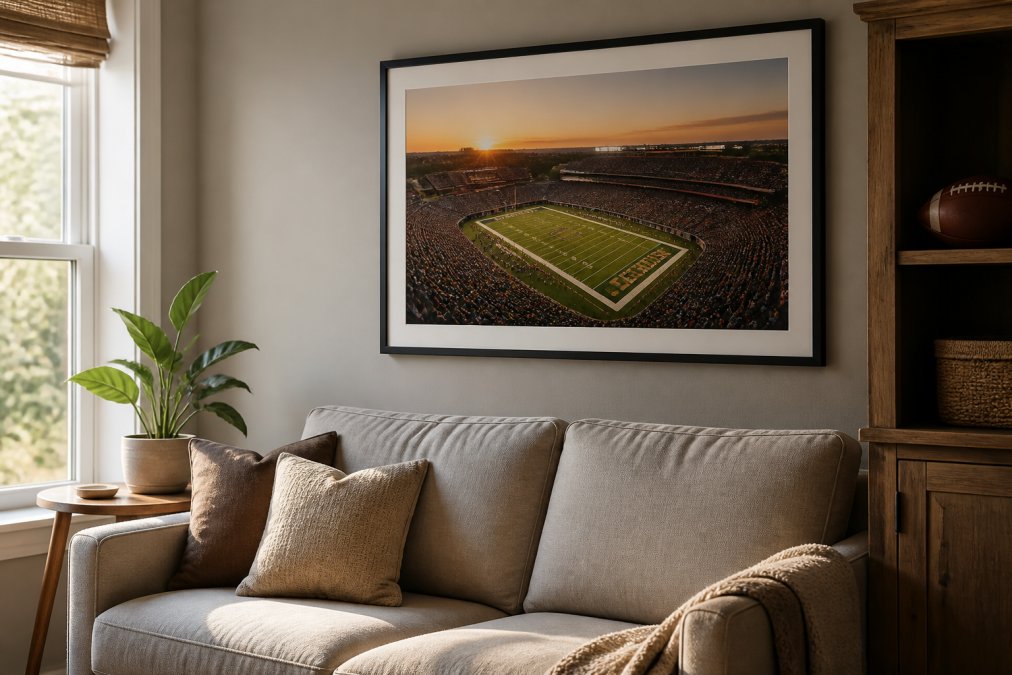
Choosing the hero piece is only half the battle. The other half is engineering the room so the art performs as the focal point. Most fans hang a print and then wonder why the room still feels flat, the reason is almost always lighting that fights the art or furniture placement that competes with it.
Lighting: The Undisputed Focal-Point Maker
Stadium photography is defined by contrast, the deep shadows of the stands, the floodlights cutting through evening air, the saturated green of the pitch. If you wash that out with a bright overhead ceiling light, you lose the entire atmosphere. The rule most interior designers follow is to use layered lighting, not a single source:
- Install a picture light (a clip-on or wall-mounted fixture) aimed directly at the print from above. This creates a pool of light that mimics floodlighting and makes the print the brightest object in the room. A common pattern is to use a warm LED with a color temperature around 2700K to avoid washing out the blues and greens in the photograph (energy.gov).
- Ditch the ceiling light as your primary source. Use floor lamps or table lamps positioned at the sides of the room, not directly above the art. This creates a gradient of light that draws the eye to the wall.
- Avoid placing the art opposite a window. Direct sunlight will cause fading over time and creates glare that obscures the image during the day. If the wall faces a window, use UV-protective glass on framed prints or consider a different wall.
Furniture Placement: The Rule of Thirds for Walls
The most common furniture mistake is placing a sofa or cabinet that is wider than the print, which visually shrinks the art. The rule is simple: the hero piece should occupy roughly two-thirds of the width of the furniture beneath it. If your sofa is 240 cm wide, your print should be around 160 cm wide. If you already own a smaller print, add flanking elements, a pair of smaller framed prints, a wall-mounted shelf with a trophy, or a vertical flag on each side, to bring the total visual width to that proportion.
Height matters just as much. The center of the print should sit at eye level, typically 145 to 150 cm from the floor (thisoldhouse.com). If you are hanging above a sofa, leave 15 to 20 cm of breathing room between the top of the backrest and the bottom of the frame.
The Gallery Wall: A Curated Alternative
A gallery wall works best when it mixes framed art with smaller memorabilia like tickets or scarves. Lay the arrangement out on the floor first to plan the spacing. Use consistent frame colours to create cohesion, and keep the grid tight, with gaps around 5 cm, so the collection reads as one curated piece.
For a stadium-themed gallery wall, the most effective pattern is a central anchor piece (your best stadium photograph) surrounded by smaller items that tell a story: a ticket stub from a memorable match, a vintage club badge, or a black-and-white photo of the old ground. Do not mix more than three frame colours, and keep the matting consistent, white or off-white mats on every piece create a museum-like coherence.
The One-Shelf Rule for Memorabilia
If you have scarves, signed balls, or trophies, resist the urge to scatter them across shelves and mantels. Designate a single floating shelf below or beside the hero print. Arrange items with height variation, a ball on a small stand, a framed scarf folded neatly, a trophy on a riser. This creates a deliberate display zone rather than a cluttered collection.
Choosing the Right Size for Your Space
Size determines whether a print feels like a deliberate design choice or an afterthought. For a living room, a single large piece, roughly two-thirds the width of your sofa, creates the strongest visual impact. In a hallway or office, a smaller framed print or a multi-panel arrangement works better without overwhelming the narrower space.
By controlling lighting, furniture proportions, and memorabilia placement, you turn a simple print into the architectural anchor of the room. That is the difference between a wall with a picture and a room that feels like a tribute to your club.
Football Stadium Canvas Prints: Framed vs. Unframed
Canvas prints are a popular choice for football stadium wall decor because they offer a gallery-wrapped, professional look straight out of the box. The key decision is whether to buy framed or unframed. Framed canvases add a polished border that suits traditional interiors and protect the edges from knocks, but they cost more and take up more visual space. Unframed gallery-wrapped canvases have a modern, edge-to-edge look that fits contemporary rooms and are lighter to hang.
For a dedicated fan cave or man cave, unframed canvases in a large format create a sleek, immersive atmosphere. For a living room that doubles as family space, a framed print tends to blend better with existing decor and signals a higher-end finish. Consider the wall colour and the room's lighting before deciding.
The Hidden Cost Difference: Framing Hardware
What most buyers do not realise is that the price difference between framed and unframed is not just the frame itself. Framed canvases typically come with a wire hanging system and wall hooks included, so the total out-of-pocket cost is closer to the listed price. Unframed gallery-wrapped canvases, however, often arrive with no hanging hardware at all. You will need to buy a hanging kit separately, typically £5 to £15. For large canvases (over 100 cm on the longest side), consider a French cleat system, which distributes weight more evenly and prevents shifting. A French cleat kit costs around £10 to £20 and is worth the investment for any piece over 10 kg.
How to Hang a Large Canvas Without Damaging Drywall
The fear of putting a nail through a wall stops many fans from buying the large-format prints that would look best. There is a safe, reversible method that most professional installers use:
- Locate the studs. Use a stud finder to mark the vertical edges of the wall studs. For a canvas wider than 90 cm, you want at least two anchor points that hit studs.
- Mark the top edge. Measure the canvas height, then mark a horizontal line on the wall at the height where the top of the canvas should sit (remember: center of the piece at 145-150 cm from the floor).
- Use two hooks, not one. Even for a small canvas, two hooks spaced apart prevent the piece from tilting. For large canvases, use two heavy-duty picture hooks rated for at least 15 kg each.
- Protect the wall with painter's tape. Before hammering the nail, press a small piece of painter's tape over the spot. This prevents the drywall from cracking or crumbling around the nail hole.
- For unframed canvases, use the tension-mount method. Most gallery-wrapped canvases have a wooden stretcher bar frame on the back. You can screw a D-ring or sawtooth hanger directly into that wooden frame, then hang it on a single nail. This avoids needing a wire and keeps the canvas flush against the wall.
If you are renting and cannot put nails in the wall, use adhesive picture-hanging strips rated for the weight of your canvas. For a 2 kg canvas, two strips rated at 2.5 kg each will hold securely. Clean the wall with rubbing alcohol first, press the strips firmly for 30 seconds, and wait 24 hours before hanging.
The Unframed Edge: What Happens to the Sides?
A key difference between framed and unframed canvases is how the image wraps around the edges. On a gallery-wrapped unframed canvas, the image either continues around the sides (full-bleed wrap), is mirrored, or the sides are painted a solid colour. Before ordering, check which wrap style the seller uses. A full-bleed wrap is ideal if you will view the canvas from an angle, such as in a hallway. A solid-colour wrap is safer if the canvas will sit close to a wall corner. Framed canvases avoid this issue entirely because the frame covers the edges, but they add 5 to 8 cm to each dimension, so re-measure your wall space.
Long-Term Durability: What to Check Before You Buy
Whether framed or unframed, the longevity of a canvas print depends on two things: the ink and the canvas material. Look for pigment-based inks (often labelled as archival or gallery-grade) rather than dye-based inks, because pigment inks resist fading from UV exposure for decades rather than years. For the canvas itself, a 350 gsm (grams per square metre) cotton-polyester blend is the industry standard for premium prints; anything thinner (under 300 gsm) may sag or warp over time, especially in humid rooms (wikipedia.org). If you are hanging the canvas in a room with high humidity, consider a framed piece with a protective backing, or apply a UV-protective spray sealant.
Whichever route you take, the goal is the same: to bring the atmosphere of your club's home ground into your own space. Original photography from Football Printz delivers authenticity and print quality. With secure shopping, quality guaranteed, and instant download options for digital pieces, you can transform your space with confidence.
Frequently Asked Questions
Are canvas prints or framed posters better for sports decor?
Canvas prints offer a modern, gallery-style look without needing extra framing, and they often work better for large panoramic shots. Framed posters provide a more classic, polished feel and can be easier to swap out when you want a change. For a dedicated fan cave, large-scale canvas prints make a bold statement. If you're decorating a living room or office, a framed poster with a sleek frame might blend in more naturally with your existing interior design.
How do I choose the right size wall art for my room?
Measure your wall space first. A common rule is that your art should take up about two-thirds to three-quarters of the width of your sofa or bed. For a large, empty wall, a single oversized canvas print creates a strong focal point. For smaller spaces, consider a gallery wall with a mix of smaller framed prints. Avoid choosing a piece that gets lost in a large room or one that overwhelms a small wall.
What is the best way to preserve sports wall art?
Avoid hanging art in direct sunlight, as UV rays can fade the print over time. Choose a spot away from radiators or vents to prevent warping. For framed posters, use UV-protective glass to maintain the color. Dust your canvas prints regularly with a soft, dry cloth. When moving or storing pieces, wrap them in acid-free tissue paper to protect the surface.
How can I style a football-themed room without it looking cluttered?
Pick one focal point, such as a large stadium canvas print, and build the room around it. Limit the number of smaller items like scarves or memorabilia to avoid visual chaos. Use a consistent color palette, often your club's colors, to tie the room together. Mix your sports decor with neutral furniture and textures to keep the space feeling intentional and stylish, rather than like a crowded trophy cabinet.