

Table of Contents
- Choosing the Right Frame for Posters and Stadium Prints
- Stadium Photography Gallery Wall Ideas for Football Fans
- How to Preserve Sports Photography Prints for the Long Term
- Best Lighting for Wall Art in Your Home
- The Best Places to Display Stadium Photography at Home
- Frequently Asked Questions
Last Updated: September 13, 2026
Choosing the Right Frame for Posters and Stadium Prints
The frame you choose does as much work as the photograph itself. A cheap, flimsy frame will drag down even a superb stadium photography print, while the right moulding and mount can make a £3.99 digital download look like a gallery piece.
Most fans get this backwards. They spend hours picking the shot, then grab whatever frame is on offer at the local shop. Here's what actually matters, in order of impact.
Stadium photography is the practice of capturing the architecture, atmosphere, and match-day energy of a football ground through high-res images, from wide-angle pitch views to floodlit night skies. How you frame and hang that image determines whether it reads as art or as a poster.
Frame Styles That Suit Football Photography
Black metal or matte black wood suits almost every stadium shot. It disappears into the image and lets the floodlights and crowd detail carry the room. For a warmer look, natural oak or walnut works well with golden-hour shots of grounds like Anfield or Elland Road.
A white frame is the sleeper pick. It lifts dark, high-contrast night shots and looks sharp against coloured walls.
Three rules that save you money and regret:
- Match frame colour to the dominant tone in the photo, not your sofa
- Add a mount board (at least 5cm) so the image breathes
- Skip ornate, gold-leaf moulding for modern stadium shots, it fights the subject
Print Specifications That Decide How a Stadium Shot Reads
This is the part almost no display guide covers, and it is the difference between a print that looks like a photograph and one that looks like a poster. Stadium photography is unusually demanding because it combines two extremes in one frame: deep shadow in the stands and blown-out floodlights on the pitch.
Resolution. For a print you intend to hang, aim for a file that gives you roughly 300 pixels per inch at the final size. A 50cm-wide print needs about 5,900 pixels across; a 70cm-wide print needs about 8,300 (printique.com). Below that, crowd detail turns to mush and floodlight halos become visible stair-steps. If you are buying a digital download, check the pixel dimensions before you commit to a large canvas.
Paper and substrate. Three options dominate for stadium work:
- Metallic paper, the sleeper choice for floodlit night shots. Its coating gives highlights a subtle sheen that mimics the way stadium lights bloom, and it deepens the blacks in the stands. It is less forgiving of soft focus, so only use it for sharp files.
- Matte or fine-art paper, the safest all-rounder. It handles wide-angle crowd scenes without glare and suits frames that will sit opposite a window.
- Canvas, the best option for very large prints because it hides minor resolution shortfalls and needs no glass. The trade-off is that canvas softens fine detail, so a 1.5m canvas of a packed stand will lose individual faces.
Glazing. Standard glass is cheap but reflects. Anti-reflective glass or acrylic costs more and is worth it for any print hung opposite a window or under a picture light. UV-filtering glazing is a separate feature, it reduces fading but does not stop reflection, so check which one you are buying (tru-vue.com).
Mounting Hardware and Hanging Essentials
The hardware nobody talks about is where most displays fail. A framed 50cm print needs a proper two-point hanging system, not a single nail.
For anything above A3, use two hooks set 10-15cm apart so the frame can't swing or tilt. For heavy canvas, a French cleat spreads the load across the wall. For renters who can't drill, adhesive strips rated well above the frame's weight work, but check the rating twice.
For large-format prints, anything over 70cm, the frame itself becomes a structural issue. A 1m-wide framed print can weigh 5-8kg once you add glass, mount board, and a solid frame. At that size, a single hook is not a hanging system, it is a countdown. Use a French cleat rated for at least twice the weight, or two heavy-duty hooks fixed into studs or masonry anchors.
Stadium Photography Gallery Wall Ideas for Football Fans
A gallery wall is the single best way to display a collection of stadium prints without the room feeling like a club shop. The trick is variety: mix sizes, mix grounds, mix eras.
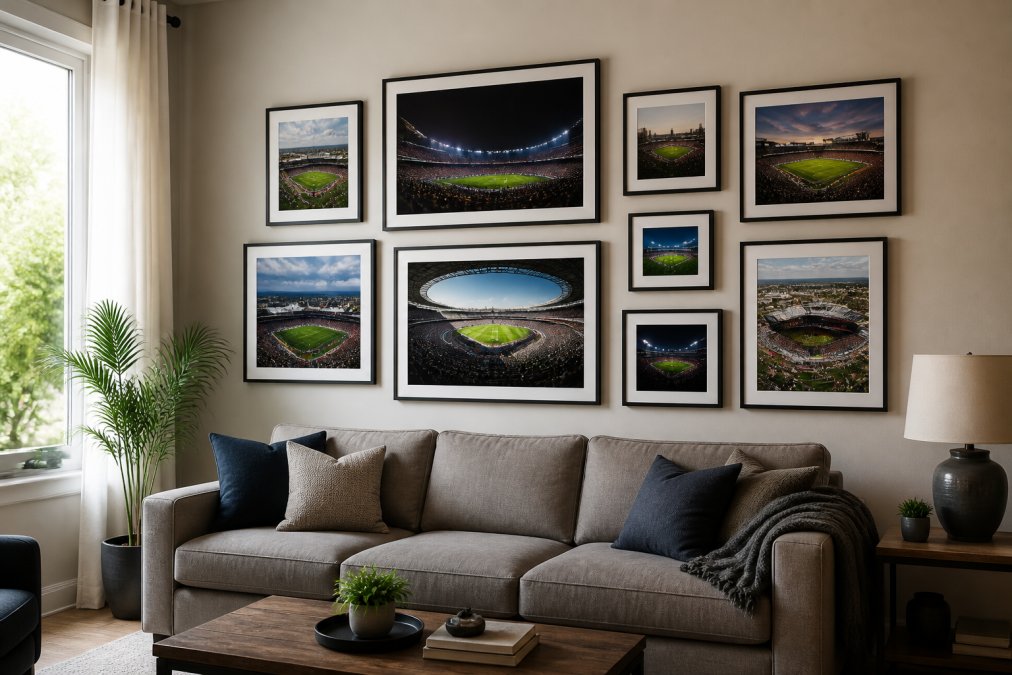
The strongest layouts follow one of three patterns:
- Grid: equal-size frames in a strict block. Best for a single club's home, away, and cup-final shots
- Salon: one large centrepiece surrounded by smaller frames. Works well when you have a hero shot of the ground
- Linear: a single row at the same height, ideal for narrow walls or hallways
Curating Stadium Photography With Memorabilia
Most gallery-wall advice stops at layout. The harder question is what actually goes on the wall alongside your stadium prints, and this is where a display either looks curated or looks like a pile of fan merchandise.
The rule that separates the two: photography carries the wall, memorabilia accents it. If more than about a quarter of the frames on the wall contain shirts, tickets, or programmes, the wall stops reading as art and starts reading as a shrine. That is fine if a shrine is what you want, but it is not a gallery wall.
A workable ratio for a mixed wall is roughly three photographic prints to one memorabilia piece. The photography sets the tone and the memorabilia adds a personal anchor.
What mixes well:
- A framed match ticket or programme in the same frame size as a small print, hung in the grid
- A signed shirt in a shallow shadow box, treated as one large frame in a salon layout
- A pin badge collection in a single multi-aperture mount, which reads as one piece rather than twenty
What fights the photography:
- Shirts hung loose on hangers, which break the flat plane of the wall
- Scarves draped over frames, which obscure the image and add visual noise
- Anything with a glossy plastic finish next to matte prints, because the two surfaces catch light differently and the wall looks uneven
Colour discipline. Stadium photography is usually dominated by green pitch, grey concrete, and floodlight white. Memorabilia is often the loudest thing on the wall, a red shirt, a claret and blue scarf. Pick one accent colour from the memorabilia and let it repeat once or twice across the wall, rather than letting every piece introduce a new colour.
Frame consistency. The single fastest way to make a mixed wall look intentional is to use the same frame profile throughout, even when the contents differ. A uniform black frame around a print, a ticket, and a shirt makes three unrelated objects read as one collection. Mixed frame styles can work, but they need a clear logic, for example, all metal frames for photography and all wood frames for memorabilia.
Layouts for Small and Large Spaces
For a small space, a vertical stack of three frames uses height instead of width and makes a cramped corner feel intentional. For a large wall, anchor the arrangement with one big canvas and build outwards.
Keep the gaps consistent, 5-8cm between frames, and treat the whole arrangement as one shape before you drill anything. Lay it out on the floor first.
How to Preserve Sports Photography Prints for the Long Term
Fading is the number one complaint from anyone who has bought a print before. The fix is straightforward, and it starts before the print reaches your wall.
Use frames with UV-filtering glass or acrylic. Keep prints out of direct sunlight, especially south-facing walls where afternoon light is strongest. Avoid hanging above radiators or in damp rooms like bathrooms, where humidity warps paper and encourages mould behind the glass.
For digital downloads, back up the high-resolution file in two places. If the print ever gets damaged, you can reprint it rather than rebuy it.
Best Lighting for Wall Art in Your Home
Lighting decides whether a stadium print looks alive or flat. The goal is even, indirect light across the surface with no glare bouncing off the glass.
Picture lights mounted above the frame are the classic solution, but they need to be angled away from the glass or you'll get a hotspot. For rooms with good natural light, position the art on a wall that receives soft, indirect daylight rather than direct sun.
If you're using spotlights, aim for a beam angle wide enough to wash the whole frame, not a tight circle in the middle. Warm white bulbs (around 2700-3000K) flatter the amber tones of floodlit stadium shots (energy.gov). Cool white makes night skies look clinical.
The Best Places to Display Stadium Photography at Home
Where you hang a stadium print changes how it reads. A framed ground shot in a living room becomes a conversation piece. The same print in a home office becomes a daily reminder of match day.
The strongest spots:
- Living room: above the sofa, in a gallery arrangement or as a single large canvas
- Home office or study: directly behind the desk, so it's in your eye line on calls
- Hallway or stairs: a linear run of prints turns a corridor into a mini museum
- Bedroom: one calm, wide-angle shot above the bed, no busy crowd scenes
At Football Printz, we've built our collection around exactly this, original stadium photography from grounds across England, available as instant digital downloads, framed posters, and canvas prints. Every image is shot by us, not pulled from a stock library, so the atmosphere you're hanging is genuine. If you want a starting point, the Old Trafford, Manchester 2026 Canvas Print is a stretched canvas over a pinewood frame, printed fade-resistant so the pitch detail holds up from across the room.

For a more flexible option, the Anfield Stadium digital photo print downloads instantly, so you can print it at whatever size suits your wall.

Frequently Asked Questions
What are the best frame styles for stadium photography?
For stadium photography, a simple black or white frame with a white mat works well because it lets the image stand out without distracting from it. Metal frames in silver or brushed steel suit modern interiors, while oak or walnut frames add warmth to traditional rooms. If you are framing a large panoramic shot, a thin frame with acrylic glazing keeps the weight down and reduces the risk of breakage. Always check that the frame depth fits your print and any mounting board you plan to use.
How do I create a gallery wall of football stadium prints?
Start by choosing a theme, such as grounds your club has won at or stadiums you have visited. Lay the frames on the floor first to test the arrangement. A common approach is to pick one large anchor print, like a canvas of Old Trafford, then group smaller prints around it. Keep 5-7 cm between frames for a balanced look. Use a spirit level and paper templates taped to the wall before drilling. Mixing frame sizes and orientations adds visual interest without feeling cluttered.
Should I use matte or glossy paper for stadium photography?
Matte paper reduces glare and reflections, which makes it a better choice for rooms with strong overhead lighting or large windows. It also gives a softer, more painterly feel that suits atmospheric floodlit shots. Glossy paper produces deeper blacks and more vibrant colours, so it can work well for high-contrast night-time images in a room where you control the light. If you are unsure, matte is the safer option for a living room or hallway.
How can I preserve stadium photography prints from fading?
Keep prints out of direct sunlight, because UV rays are the main cause of fading. Use UV-filtering glass or acrylic when framing, and choose archival-quality mounts and backing boards that are acid-free. Avoid hanging prints in damp rooms such as bathrooms or kitchens, where humidity can cause warping or mould. If you store spare prints, place them flat in a dark, dry place between sheets of acid-free tissue. Following these steps will help your prints last for many years.