

Table of Contents
- What Makes Stadium Photos Authentic: The Core Elements
- Best Practices for Stadium Photography: What to Look For
- The Difference Between Original Stadium Photography and Stock Images
- Trademark, Copyright, and Commercial Use: What Every Fan Should Know
- Where to Find Vintage Stadium Posters and Original Prints
- Football Stadium Wall Art Prints: Choosing the Right Piece for Your Home
- Frequently Asked Questions
Last Updated: September 16, 2026
What Makes Stadium Photos Authentic: The Core Elements
Authenticity in a stadium photo comes from three things you cannot fake: real light, real atmosphere, and a real moment that will never happen again. According to FIFA's guidance on football photography and fan media, the game's governing body treats matchday imagery as part of the sport's cultural record, which is exactly why a genuine shot carries weight that a staged one never will. This guide from Football Printz breaks down what separates an authentic stadium photo from a stock image, how to shoot one properly, and what every fan should know about copyright before framing it.
Here is the key insight most people miss: authenticity is not about technical perfection. A slightly grainy shot of a floodlit stand, taken from row 34 with a phone, can feel more real than a crisp studio image of the same ground.
Lighting, Atmosphere, and the Unrepeatable Moment
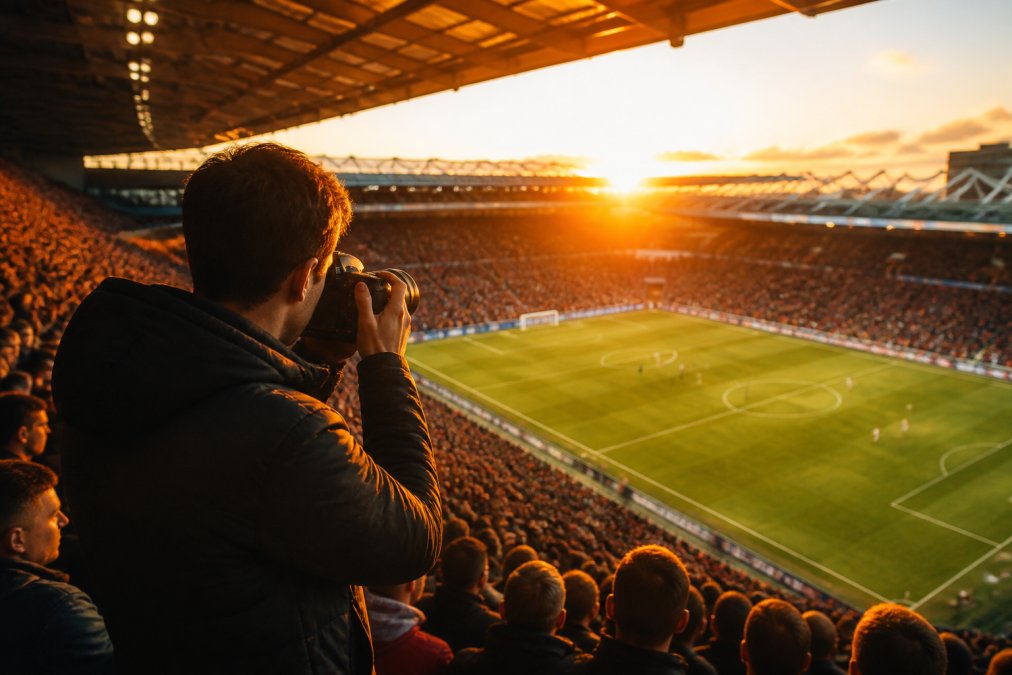
Stadium light changes everything.
Framing and Composition That Tell a Story
Composition turns a record shot into a photograph. The difference is intent: a snapshot points at the pitch, while a composed frame decides what the viewer should feel.
Three composition choices do most of the work:
- Leading lines: Use the stands, stairways, or touchline to pull the eye toward the centre circle.
- Scale: Include a person, a corner flag, or a turnstile to show how vast the ground really is.
- Foreground framing: Shoot through a barrier, railing, or between two heads to add depth and a sense of being there.
Best Practices for Stadium Photography: What to Look For
The best practices for stadium photography come down to preparation and restraint. Know your settings before kick-off, respect the people around you, and shoot the moments between the action, not just the action itself.
Technical Settings That Separate Pros from Snapshots
Getting the exposure right is what separates a usable image from a blurry one. Stadiums are a low-light environment, and your camera needs to be set up before the lights drop.
| Setting | What to Use | Why It Matters |
|---|---|---|
| Shutter speed | 1/500s or faster for action | Freezes players and avoids motion blur |
| Aperture | f/2.8 to f/4 | Lets in more light in the stands |
| ISO | 1600-6400, as needed | Brightens dim scenes but adds grain |
| Focus mode | Continuous autofocus | Tracks moving subjects |
| Metering | Spot or centre-weighted | Handles bright pitch against dark stands |
The Difference Between Original Stadium Photography and Stock Images
Original stadium photography is shot by a person who was actually there, at a specific match, on a specific day. Stock images are licensed, generic, and often shot at empty grounds with no crowd at all.
Trademark, Copyright, and Commercial Use: What Every Fan Should Know
Copyright in a stadium photograph belongs to the person who took it, not to the club and not to the fan in the picture. That single rule answers most of the questions fans ask, but the practical reality is more nuanced. Understanding where your rights end and someone else's begin is essential, especially if you plan to share, print, or sell stadium imagery.
Copyright: Who Owns What
When you take a photo inside a stadium, you own the copyright to that image. The club does not own it, the league does not own it, and the fans in the crowd do not own it. This is true even if you are standing on private property, because copyright protects the creator of the work, not the owner of the venue.
However, there are limits:
- Private property rules still apply. A club can restrict photography in its terms of entry, and stewards can ask you to stop or leave if you violate those terms. That is a matter of contract, not copyright.
- Photographs of people may require consent if the person is identifiable and the image is used commercially. In a crowded stadium, this is rarely practical, but it is a consideration for close-up shots of individual fans.
- Photographs of buildings taken from a public place are generally fine for personal use, but commercial use may require a property release if the building is trademarked or has protected design elements.
Trademark: When Club Crests and Names Become a Problem
Trademark is a separate issue from copyright. Club names, crests, and slogans are protected marks, and using them on merchandise you sell can infringe those rights. The UK Intellectual Property Office guidance on copyright and trademarks is the clearest starting point for anyone unsure where the line sits.
- Editorial use, using a photo in a news article, blog post, or social media post to report on or comment on a match, is generally protected, even if club crests are visible.
- Commercial use, using a photo on a product you sell, like a mug, t-shirt, or poster, requires permission from the trademark owner if the crest or name is prominent.
For everyday fans, the practical rules are simple:
- Printing a photo you bought for your own wall is fine.
- Reselling, redistributing, or using it commercially is not, unless you have permission.
- Photographs of a public building taken from a public place are generally fine for personal use.
Ethical Fan Photography: Capturing Crowds Respectfully
One area most guides ignore is the ethics of photographing fans. Stadiums are public spaces, but the people in them have a reasonable expectation of privacy. Authentic crowd shots can be powerful, but they should never come at the expense of someone's dignity.
- Avoid exploiting distress. If a fan is crying, injured, or in an altercation, do not photograph them without consent.
- Respect children and vulnerable people. Never photograph minors without a parent's permission, and avoid singling out individuals who may not want attention.
- Focus on the collective, not the individual. Wide shots of a singing crowd capture the atmosphere without invading anyone's privacy.
- Be transparent. If someone asks you to delete a photo of them, do it. It costs you nothing and preserves trust.
Where to Find Vintage Stadium Posters and Original Prints
Vintage stadium posters and original prints are best found through specialist photography sellers and independent print shops rather than mass-market retailers. The trade-off is simple: you pay more for something genuine, and you get a piece with a real provenance behind it.
- Provenance: Who took the photo, and when? A named photographer is a good sign.
- Licensing: Is the image cleared for the print size you want?
- Print quality: Archival paper and long-lasting inks stop the fading that ruins cheap posters.
Football Stadium Wall Art Prints: Choosing the Right Piece for Your Home
Football stadium wall art prints work best when they match the room, not just the club. A large panoramic shot of a full ground suits a wide living-room wall, while a tighter framed print of a single stand fits a hallway or office.
Frequently Asked Questions
What elements define an authentic stadium photograph?
An authentic stadium photo captures a specific, unrepeatable moment: the exact light, the crowd's mood, the angle only available from that seat. It shows real architectural detail, genuine atmosphere, and natural imperfections that stock images lack. Look for original framing, consistent lighting across the scene, and details like scarves, banners, or worn concrete that prove the photographer was actually there.
How can you tell if a stadium photo is professionally captured or stock?
Check for depth of field, sharpness, and whether the crowd looks natural rather than staged. Professional stadium photos often use a wider aperture to isolate the subject, while stock images tend to be overly polished and generic. Original prints from Football Printz, for example, include specific details like the Stretford End seating display at Old Trafford or Anfield's floodlit stands, which stock libraries rarely capture with that level of specificity.
Are stadium photos considered authentic if they are digitally edited?
Yes, as long as the edit enhances rather than fabricates. Adjusting exposure, contrast, or colour to match what the eye saw is standard practice. Authenticity breaks down when elements are added or removed to create a scene that never existed. Football Printz states its images are professionally edited for colour and sharpness while remaining original photographs of real grounds like Old Trafford, Anfield, and the Racecourse Ground.
Why does original stadium photography resonate more with football fans?
Original photography connects fans to a specific matchday memory or the feeling of standing in their club's home ground. Unlike generic stock shots, an original image of Old Trafford or Anfield carries the weight of real history and atmosphere. Fans want wall art that reflects their personal connection to the club, not a mass-produced image anyone could buy. That emotional link is what makes original prints worth displaying.
Choosing stadium art is really a question of what you want to feel every time you walk past it. A generic print fades into the background; a real photograph of a ground you love keeps the matchday alive. Football Printz offers original stadium photography as high-quality digital downloads and framed prints, with instant download options, secure shopping, quality guaranteed, and a 30-day hassle-free returns policy. Get started with Football Printz and bring your club's home ground onto your wall.