

Table of Contents
- What You'll Need Before You Start
- Step-by-Step: How to Clean Framed Stadium Prints Safely
- The Best Glass Cleaner for Framed Art (and What to Avoid)
- Cleaning Acrylic vs Glass Frames: Key Differences
- How to Prevent Dust in Picture Frames Long-Term
- Common Mistakes That Damage Stadium Prints
- Conclusion: Keep Your Football Memories Looking Sharp
- Frequently Asked Questions
Last Updated: September 18, 2026
What You'll Need Before You Start
Learning how to clean framed stadium prints starts with the right supplies. Grabbing the wrong cloth mid-clean is how most damage happens.
Here's what to have ready:
- Two microfiber cloths (one for dust, one for wet work)
- A lint-free cloth for drying
- Distilled water in a spray bottle
- A mild, non-abrasive cleaner or dedicated glass cleaner
- A soft, dry microfiber duster or clean paintbrush
- Archival-quality materials if you ever need to reframe
Skip paper towels, old t-shirts, and kitchen sponges. All three scratch glass and acrylic, and paper towels leave lint in the frame's corners.
Framed sports memorabilia sits in living rooms, dens, and hallways where dust, humidity, and sunlight do slow damage.
Step-by-Step: How to Clean Framed Stadium Prints Safely
Follow these steps in order. The job takes about 15 minutes for a standard frame, most of it drying time.
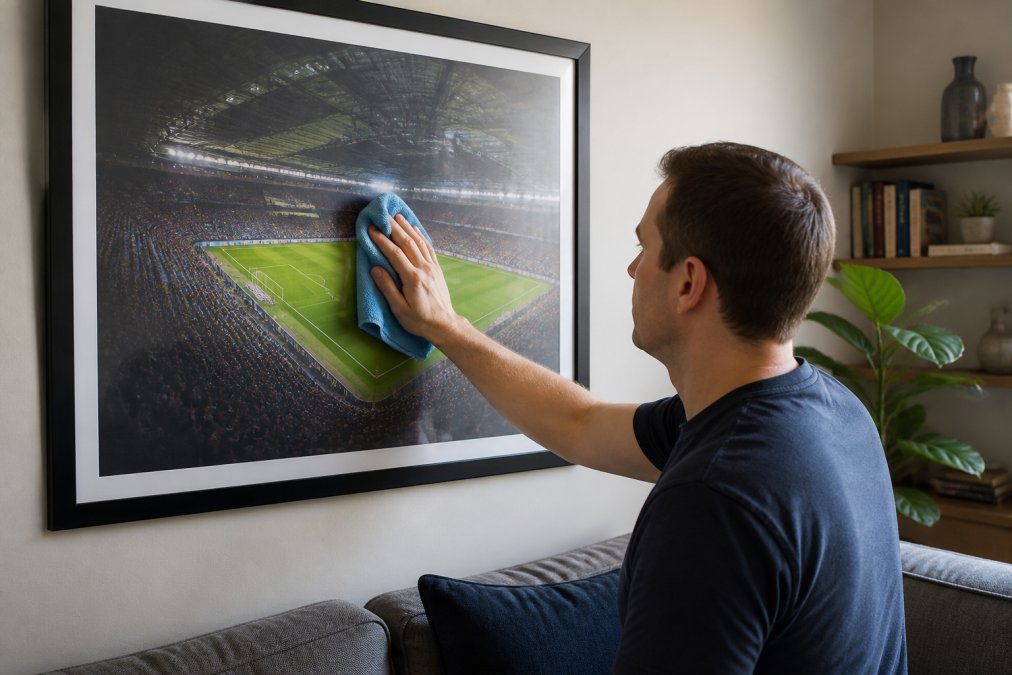
Dusting vs. Deep Cleaning: Which Does Your Print Need?
Dusting handles routine upkeep; deep cleaning is for when dusting isn't enough. Knowing which you need prevents over-cleaning, which wears down frames and coatings faster than dirt does.
Deep clean only when you spot one of these:
- Visible smudges or fingerprints on the glass
- A hazy film that won't wipe away dry
- Sticky residue near the frame edges
- Dust built up inside the frame itself
Cleaning the Frame Molding and Mounting Hardware
The frame needs different care than the glass. Wood, metal, and composite moldings react differently to moisture, so match your method to the material.
The Best Glass Cleaner for Framed Art (and What to Avoid)
The best glass cleaner for framed art is a mild, ammonia-free solution diluted with distilled water. Ammonia and alcohol cloud acrylic and damage some frame finishes over repeated use.
| Cleaner Type | Safe for Glass | Safe for Acrylic | Notes |
|---|---|---|---|
| Ammonia-free glass cleaner | Yes | Yes | Best all-round choice |
| Distilled water + mild soap | Yes | Yes | Safest option, needs buffing |
| Vinegar solution | Yes | No | Can cloud acrylic over time |
| Ammonia-based cleaner | Yes | No | Attacks acrylic and some finishes |
| Alcohol wipes | Yes | No | Strips protective coatings |
Cleaning Acrylic vs Glass Frames: Key Differences
Acrylic and glass need different handling, and mixing them up is one of the fastest ways to ruin a frame. Acrylic scratches easily; glass is heavier and chips at the edges.
Rules for acrylic:
- Never use dry cloths on a dusty surface. Dust first with a soft brush
- Avoid ammonia, alcohol, and vinegar entirely
- Use only non-abrasive cleaner and plenty of moisture to lift grit
- Never press hard. Acrylic flexes and can touch the print behind it
Rules for glass:
- Ammonia-free cleaner works fine
- Wipe in one direction to avoid streaks
How to Prevent Dust in Picture Frames Long-Term
Prevention beats cleaning every time. A few small changes cut how often dust settles on your frames and how much reaches the print inside. The goal isn't a dust-free room, but a frame that resists dust ingress and a print that stays stable.
Placement: where dust comes from
Dust is a mix of skin cells, fabric fibers, pollen, and outdoor particulate. It travels on air movement, so the spots with the most airflow collect the most.
- Keep frames away from open windows, air vents, ceiling fans, and doors that swing often. These are dust highways.
- Hang prints on interior walls rather than exterior ones. Exterior walls see wider temperature swings, which cause frames to expand and contract and open tiny gaps at the joints.
- Avoid hanging directly above radiators, fireplaces, or heating vents. Rising warm air carries dust and dries out wood frames.
- In kitchens, keep prints away from the stove. Cooking aerosol is sticky and turns dust into a film that is much harder to remove.
Humidity and temperature: the numbers that matter
- High humidity swells wood frames and softens adhesives.
- Low humidity dries wood and can cause joints to open, letting dust into the frame.
- Rapid swings are worse than a steady slightly-high reading. A frame that moves between 30 and 70 percent humidity will warp faster than one held at 55 percent.
- A cheap hygrometer takes the guesswork out. Check it monthly and adjust with a dehumidifier or humidifier as needed.
Sealing the frame back
Most dust inside a frame enters through the back, not the front.
- Inspect the dust cover for tears, lifted edges, or gaps at the corners.
Display cases and shadow boxes
- Avoid sealing a print in a case if it is not fully dry or if the room is humid. Trapped moisture is worse than dust.
- If the case has a glass or acrylic front, clean it the same way you clean a frame: dust first, then a non-abrasive cleaner on a microfiber cloth.
Storage: dust does not stop when the print comes off the wall
Stored prints collect dust too, just more slowly. If you rotate your collection or keep backups, store them properly.
- Store flat, not rolled, unless the print was shipped rolled and needs to relax. Rolling puts stress on the paper and can cause it to curl when reframed.
- Keep stored prints in a cool, dry place away from basements and attics, which swing in humidity.
- Do not stack heavy items on top of stored prints. Pressure can emboss the paper and leave marks that show under raking light.
A realistic maintenance schedule
- Weekly: quick dry dust of the frame top edge and glass with a microfiber cloth.
- Every two to four weeks: full dry dust of frame, glass, and molding grooves with a cloth and soft brush.
- Every three to six months: inspect the back, check hardware, and look for dust inside the glass.
- Annually: check humidity stability, inspect the dust cover, and assess whether any frame needs resealing or reframing.
When prevention has already failed
If you see dust inside the glass or a wavy print, prevention is no longer the answer. Those signs mean the frame needs opening, cleaning, and resealing by a framer. Don't vacuum or blow dust out from the outside; you'll push it deeper and risk scratching the glazing.
Common Mistakes That Damage Stadium Prints
Most damage to framed prints comes from good intentions. People clean more often and more aggressively than they should, and the print pays for it.
Here are the mistakes we see most:
- Spraying cleaner on the glass. Liquid seeps behind the frame and reaches the print. Always spray the cloth
- Using paper towels or tissues. Both scratch glass and acrylic and leave lint behind
- Cleaning in circles on a dry surface. Grit gets dragged across the pane and leaves swirl marks
- Using ammonia or alcohol on acrylic. These cloud the surface and strip protective coating
- Cleaning in direct sunlight. The glass heats up, the cleaner dries too fast, and streaks bake on
- Ignoring the frame back. Rusty mounting hardware and damp backing damage the print from behind
- Over-cleaning. Every wipe carries a small risk. Clean when needed, not on a strict schedule
Conclusion: Keep Your Football Memories Looking Sharp
Cleaning framed stadium prints comes down to a simple routine: dust often, deep clean rarely, and match your method to the material. Get that right and a framed print stays vivid for years.
Frequently Asked Questions
Can I use Windex on framed stadium posters?
Avoid standard Windex or any ammonia-based cleaner on framed stadium prints. Ammonia can cloud acrylic glazing and damage protective coatings over time. Instead, use a non-abrasive cleaner made for framed art, or a mix of distilled water and a drop of mild soap. Always spray the cloth, never the frame, so liquid does not seep behind the glazing and reach the print. For the best glass cleaner for framed art, look for ammonia-free formulas labelled safe for coated or conservation glass.
How often should I clean my framed sports photography?
Most framed stadium prints need a light dusting every two to four weeks, depending on how much dust your home collects. A full deep clean, including the glazing and frame molding, is usually enough two to three times a year. Prints hung near a kitchen, open window, or busy hallway gather dust faster, so check them more often. Regular dusting is preventative care that stops surface debris from bonding to the glazing and keeps display longevity intact.
How do I remove dust from the inside of a picture frame?
Dust inside the frame means the seal has failed or the print was framed in a dusty room. Take the frame down and lay it face-up on a clean, soft surface. Remove the backing paper and mounting hardware carefully, then lift the glazing away. Use a clean, dry microfiber cloth or a soft brush to wipe the print surface gently, working from the centre outward.
What materials should I avoid when cleaning framed art?
Skip paper towels, tissue, and rough cloths, which can scratch acrylic glazing and leave lint behind. Never use ammonia-based glass cleaner, abrasive creams, or kitchen sprays on a framed stadium print. Avoid spraying liquid directly onto the glass or acrylic, since residue and moisture can reach the artwork. Also stay away from alcohol wipes on coated or UV-protective glass, as they can strip the protective coating and reduce UV resistance.
Caring for a framed print is easy once you know the material and skip the harsh cleaners. Choosing a print worth caring for is the harder part. Football Printz helps fans do both, with original stadium photography, fade-resistant printing, and a 30-day hassle-free returns policy on every order. Shop now and bring the atmosphere of your club's home ground into your home.